There are numerous types of paratext used in the castell of helth but the one that interested me the most was the typography. The typography used in the castell of helth includes Blackletter typeface. Blackletter typeface, also known as Gothic or Old English typeface, plays a prominent role in the history of typography within Western European works. Blackletter was used in the Gutenberg Bible, one of the first printed books in Europe. This typeface is characterised by the difference between thick and thin strokes which creates a distinct and conspicuous font. There is a wide variety of Blackletters. The Blackletter used in the castell of helth is Textur. When compared to other types of Blackletters, Textur looks a bit more dramatic. The sharp, straight edges of the letters seem much more pronounced in comparison to the sweeping curves of other types of Blackletters such as Rotunda or Schwabacher. The capital letters in particular consist of more decorative strokes than other types of Blackletters. It is clear that when deciding on a font for this text, the goal was to use a typeface that could easily draw attention. The format of the text on each page also seems to have been designed to be as eye-catching as possible while still remaining functional. Instead of simple large blocks of text, throughout the book a variety of means are used to creatively display the text. On some pages information is grouped together by large cursive brackets. On other pages the paragraphs start with a long sentence or phrase and then with each additional line the phrase becomes shorter until the last line is a single world. This creates a paragraph that tapers towards the end of the page. It’s interesting to note that other than the typography, other aspects of the book have rather simple designs. The front cover of the book for example, only consists of a single stamped design. There are two probable reasons for why the typography was the only elaborate addition to this text: 1. This was a tactic to keep the cost of production low by foregoing fanciful illustrations and bindings 2. The author or publisher was interested in keeping the focus of the book on the written information and therefore designed the castell of helth to have a noticeable contrast between simple binding and elaborate typography.
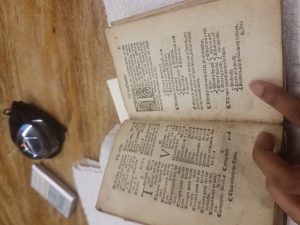
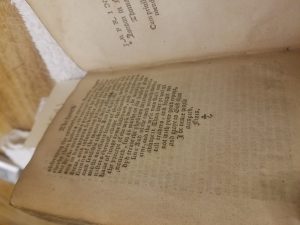
Despite the advantage of a striking typeface capturing the attention of potential buyers there are many more disadvantages to the use of Blackletter typeface in the castell of helth. For one, Blackletter typeface is notoriously difficult to read and is typically only used to emphasise headings, not type an entire book. For this reason many printers began to move away from Blackletter typefaces in the 1500s. The castell of helth was published in 1541. The castell of helth was written with the intention to make knowledge on healthcare more accessible to the public. Using a typeface that is both difficult to wield and had a waning popularity seems counterintuitive to this goal. At the time of publication of the castell of helth, Blackletters were mostly seen in texts from Germany and other German speaking countries. However, the castell of helth was written by Sir Thomas Elyot, an Englishman and was printed on Fletestreet (Fleet Street), a popular printing district in England so the area of origin could not have been the reason for using Blackletter typeface. Whatever the reason was for using Blackletter typeface, it definitely influenced which potential readers would buy the book. Those who appreciate elaborate type and who can actually read those types were much more likely to be the owners of a copy of the castell of helth.
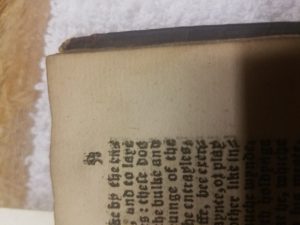
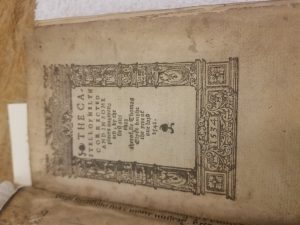
Another interesting factor of the typography of the castell of helth is the format of the page numbers. The page numbers in the text appear on the upper right hand corner of a page but what’s interesting is that not every page is numbered. The pages that are numbered don’t seem to be in actual numerical order. At first I though that perhaps some of the pages for this copy of the castell of helth was missing or maybe this was a printing error. However, I found a copy of the castell of helth that was being sols on ebay and this copy also had the same format for the page numbers. The digital copy of the book available in the Library of Congress’ Digital Collection was a bit different. Not every page was numbered but it did seem that the pages were actually in some type of order. After examining all the versions of the book it seems likely that the page numbers are in numerical order, but because so many pages got skipped it seemed that they are not. The printer could have placed the page numbers only on a few pages to help keep track of which order the pages needed to be in for binding. It is also possible that the page numbers are there to help readers keep track of where they are in the book but the type used to print the book, did not have all the needed numbers.
References
Oxford Dictionary of National Biography. Elyot, Sir Thomas. https://www.oxforddnb.com/view/10.1093/ref:odnb/9780198614128.001.0001/odnb-9780198614128-e-8782
SitePoint. The Blackletter Typeface: A Long and Colored History. https://www.sitepoint.com/the-blackletter-typeface-a-long-and-colored-history/
HathiTrust Digital Library. Catalog Search Results. “Elyot, Thomas, Sir, 1490?-1546.”. https://catalog.hathitrust.org/Search/Home?lookfor=%22Elyot,%20Thomas,%20Sir,%201490?-1546.%22&type=author&inst=
Library of Congress. Digital Collections. From the Rare Book and Special Collections Division. http://lcweb2.loc.gov/cgi-bin/ampage?collId=rbc3&fileName=rbc0001_2011bit64805page.db&recNum=35