Special Pages to this book:
- One important thing to notice before taking a closer look at any older books is to understand how the book is structured in terms of the content it contains and the order of the content
- This is mainly due to the difference between the different writing habits and tools used by us and people in the past
- By skimming through my book, I notice some special pages and notations unique to my book when comparing to my other modern books
-
Title page
After opening my book, the first page you will see is the title page:
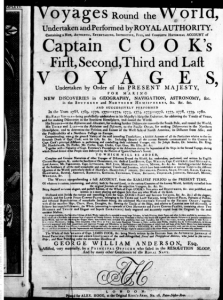
On this page, you will see the title of the book, the author’s name, and more importantly—a brief summary of the book’s content.
From this page, people can see that the book is separated to 3 parts, corresponding to the 3 voyages taken by Captain Cook.
With the help of this page, the user will get a sense of what this book talks about before taking a closer look at the rest of the pages.
The special thing about this page is that we don’t normally see a book that gives out the summary right away nowadays. Usually, our title page would be very brief like this one:
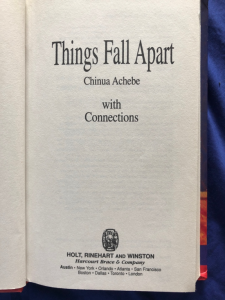
In this case, it may just be that the purpose of my pet book is different from that of the other novels that I read before, or it’s just the writing tradition changed through times. The answer of this question would be found out after I have the chance to examine the other old books of similar time period.
-
Chapter summaries
Not only does the book have a general summary on the title page, but also there are summaries of the chapters before each chapter:
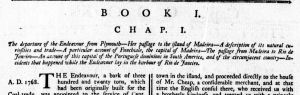
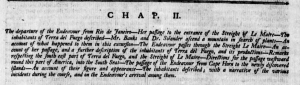
I also don’t normally see this kind of text among other books I read, but by inferring from the purpose of this book—record of the journey taken by captain cook, I believe the purpose of the chapter summary is that the author wanted to better lead the reader through the book so that when the reader wants to look up one specific record, the reader can locate that piece of text without reading the whole chapter.
-
Running titles
The running title for this book is also interesting as it also contains a form of summary:


Different from the two other forms of summaries mentioned above, those are the summaries to each page.
Due to the fact that there are already 3 forms of summaries present in the book, it occurs to me that the purpose of this book is more likely to be storing the discoveries made by Captain Cook than be regarded merely as a storytelling book since the structuring of the book focuses a lot on the user’s accessibility to the content.
-
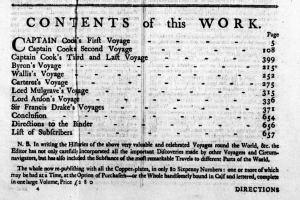
Table of Content
Different from the modern books, the table of content of my pet book is at the end of the book:
-
Fonts
Different font styles are used in the book for the separation of contents.
On the title page, we can easily see different font sizes:
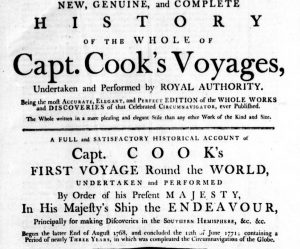
Normally, the title would be the biggest and the author’s name would also be bigger than other content.
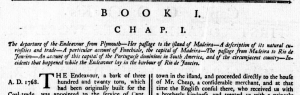
In order to make a difference between the summary and the rest of the article, the summary is printed using another font-a slightly more italicized and smaller font than the regular ones.
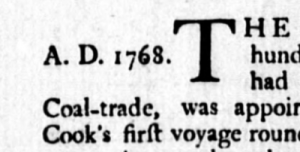
The first letter of the paragraph is also enlarged both for grabbing the reader’s attention and aesthetic reason.
-
The subscribers’ page
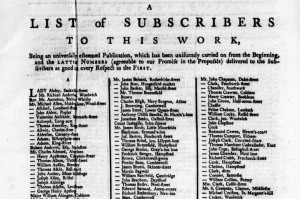
Since in the past, if the printer wants to print 100 books, the printer would need to print half of the books (100 half-books) before the full books can be sold to the booksellers. In this case, some printers may prefer to have subscribers who are promised to buy books from the printer after the books are printed.
In this case, the printer wouldn’t need to worry about how he or she would get the money back.
For my pet book, it includes a list of subscribers who will receive this edition of my pet book after its publication:
- Directions to book binding
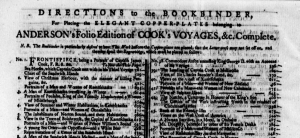
Since most of the author isn’t also the binder, it may happen that the binder binds the books in a way that the author isn’t intend to. In this case, the way that Anderson solves this issue is by including a “directions to book binder”.
It seems that on this page, there are information about the ordering of pages so that the book binder wouldn’t bind the book in a wrong order if this page is followed.
Conclusion
It’s always a lot of fun for looking at how people in the past achieved different goals when presenting the book to the reader and to check whether we have better tools to reach that same goal or we continue to use tools developed in the past.