Bible interpretation is crucial to all of the many different kinds of Christian faith, Since there is no single version of the Christian Bible, and each story can be interpreted in many different ways, interpretation is an ongoing process. There are many ways to teach the same text, after all, and religion is rife with debate and internal contradiction.
In this colophon, a few names are mentioned as contributing their commentary and additions: Nicholas de Lyra, Paul Burgos, and Mathias Doering. Each of these men adds something to the book that is not strictly the text of the New Testament, making it paratext. I discussed Nicholas de Lyra in my last blog entry, though I feel as though here I should go into depth about his interpretation of the Bible. de Lyra believed that the Bible should only be interpreted literally. His strong belief in interpreting the literal meaning of the bible, as opposed to the allegorical or metaphorical meanings, led him to become frustrated with other biblical scholars of his time. He argued that the literal meaning should be preserved, not obscured and that the literal meaning had become someone lost in catholicism. This was because according to de Lyra, of failures of translators and correctors; he also believed that the text has become distorted due to neglecting the literal meaning in favor of the mystical. In order to correct this, de Lyra argued that in the tradition of Saint Jerome the bible should be cross-referenced the original Hebrew and Greek writings in order to recapture the ‘true’ meaning of the Bible. His main contribution to catholicism is the Postillae Perpetuae, a commentary on the bible with a focus on the literal meaning. This is what the commentary on the New Testament in my pet book is. (source, source.)
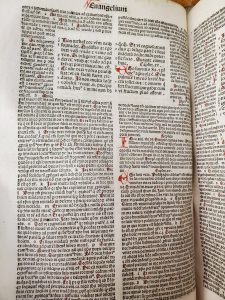
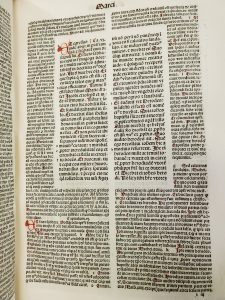
The rectangle of text in the middle of the page is the New Testament in Vulgate Latin. The text incasing the New Testament is de Lyra’s commentary. The commentary greatly outnumbers the text it is a commentary on. If one looks closely at the margins on the left of the New Testament, one can see letters. These letters are a reference system, and each letter is connected to a piece of commentary of de Lyra’s. Book historian Edward Kwakkel recognized these as a precursor to our modern footnote. He also mentions that these were often used in books designed to teach.
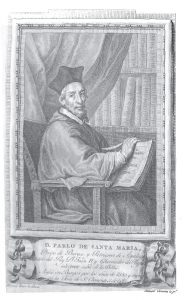
Paul of Burgos is a fascinating historical figure. Born as a Jew in the mid-14th century, he was a rabbi of Burgos and was renowned for his familiarity with the Talmud and his skills as a rabbi. However, he converted to Catholicism after claiming to see the logic of Thomas Aquinus and was baptized in 1390. After his baptism, Paul played a key role in persecuting other Spanish Jews. He was responsible for a number of antisemitic laws and worked hard to convert other Jews and rabbis to the catholic faith. Eventually, he was promoted to archbishop. His relevance to my pet book is his additions to the Postillae Perpetuae. In this, he had written marginalia in a copy of the Postillae that he sent to his son. After this, these notes were published alongside the Postillae. (source, source, source)
Matthias Doering was a Friar born in the late-14th / early-15th century. after being educated at Oxford, he taught in Germany as a theologian and lectured on Bible exegesis. Upon reading the criticism Paul of Burgos wrote about the Postillae Perpetuae, he put pen to paper and wrote the Defensorium postillae Nicolai Lyrani. While I don’t read Latin, I know a cognate when I see one: He is defending the work of de Lyra against the criticism of Paul of Burgos. (source, source)
UPDATE: When looking at the paratext of the book, one can see that the commentary of the book is written in the same size and font of the New Testament itself. It’s possible that this implies that the person who decided the paratext of the book decided that both the New Testament and the interpretation of the New Testament hold equal weight in the eyes of the Catholic church. But why would that be? Well, since in Catholicism the role of priests and bishops in the catholic church is to connect their parishioners, their interpretations of the texts would be in the service of God, so they would be treated with the same amount of respect as the word of God himself.
All of these commentaries are working together in tandem to create a conversation. Unfolding alongside and after the words of the New Testament is a debate on what the nature of the Bible, one of the key pillars of Catholicism, should be. Collecting them together reveals an interesting truth about the nature of religion: theology is dynamic. This Vulgate Bible is not just meant to be used for the text, but also to demonstrate different ways of interpreting and teaching the word of God. This, combined with the footnoting style, leads me to believe that this book may have been used to instruct student theologians in Bible interpretation.