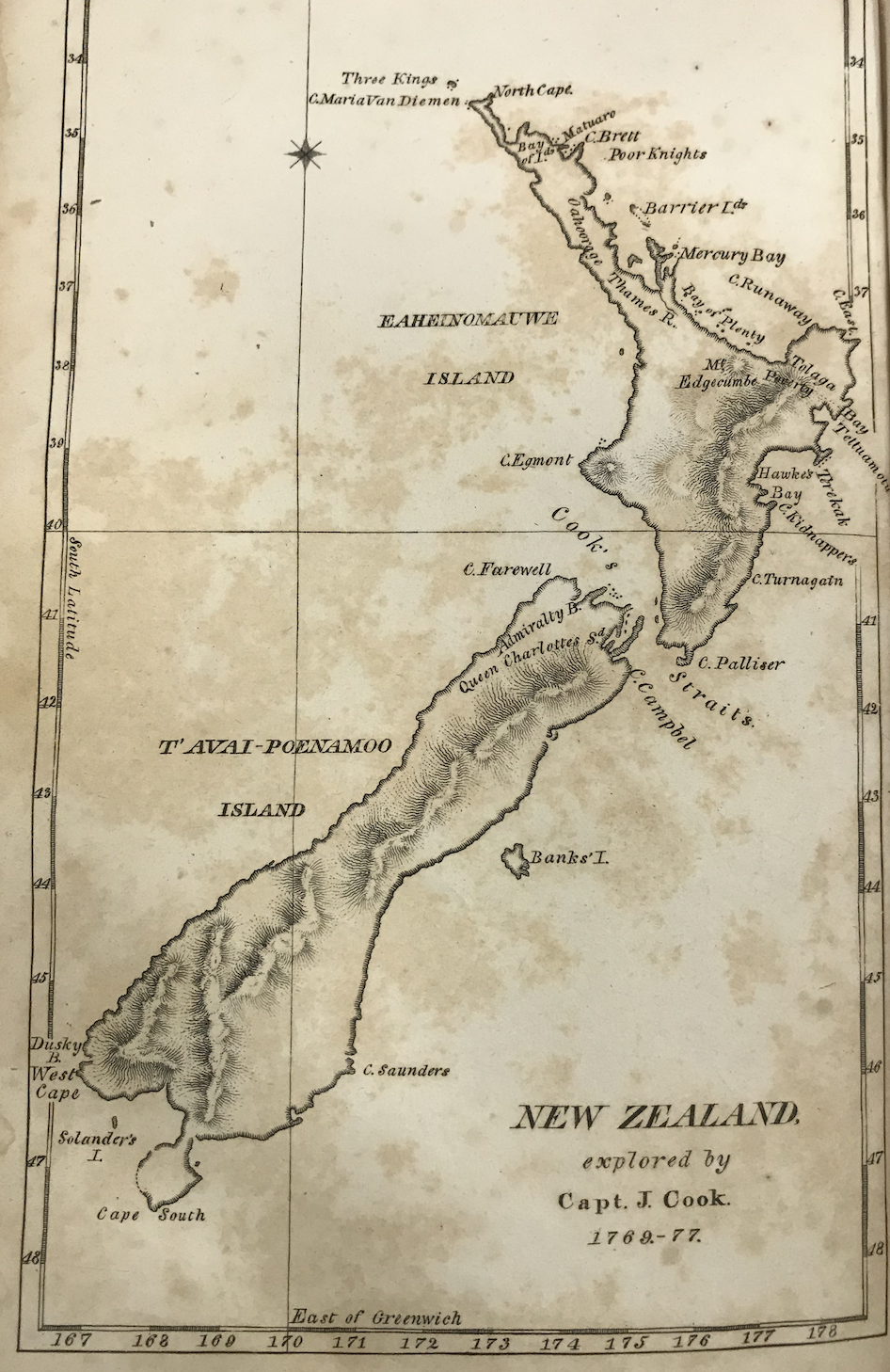
History of New Zealanders began, surprisingly enough, in Boston. The publishing company was Lilly, Wait, Colman and Holden, which had several popular releases in the early 19th century. The database firstsearch.oclc.org has an extensive list of Lilly, Wait, Colman and Holden publications, with a range of publication dates from 1833 to the mid-1840s. Most of the Lilly, Wait, Colman and Holden publications are from 1833. Analyzing the texts that were released this year, there are some clear patterns. For instance, during their run, Lilly, Wait, Colman and Holden had focus on certain topics. Most of the releases are of historical people (eg. The life and writings of Major Jack Downing, of Downingville, away down East in the state of Maine), historical locations (eg. History of Boston by Robin Carver), or historical events.
One particular book also published in 1833, Paris, or the book of the hundred-and-one, has many intriguing similarities to History of New Zealanders. In a side-by-side comparison of the last pages of both texts, the similarities become clear.
— Paris is on the left, New Zealanders is on the right. —
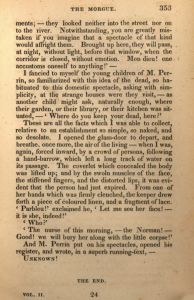
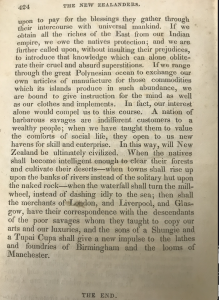 In these images, the fonts are nearly identical in size and shape and the formats, specifically the location and appearance of section titles and page numbers, are quite similar. Both texts were released in the same year, with the same font, layout, and chapter structure. The small ‘VOL. II; in the bottom corner of Paris mirrors the ‘VOL. V’ in New Zealanders as well, which appears every few pages. I was unable to track down any other volumes of either text. The most striking similarity is that neither lists an author. The lack of authors and similarities in structure appear to be an intriguing coincidence. Are the two texts, which have a surprising amount of similarities, part of a collection?
The largest mystery of History of New Zealanders is the author. It appears to have none, and there is no reference to any specific writer among online databases. The only aspects of the creator that I have been able to determine are that they are likely a man and they are likely from England. The gender of the author is clear from the advertisement at the beginning of the text.
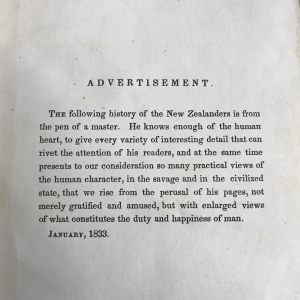 The advertisement is similar to a review that may be found in modern books and acts as a promotion of sorts. He has “practical views of the human character, in the savage and civilized state” and is referred to as a “master.” There is also no declaration of who penned the advertisement, which makes me question the validity of the appraisal. The geographical origin of the author was more complicated to deduce. From the language used in the text itself, I was able to assume that he was familiar with English geography. On the final page, he references the folks of “London, Liverpool, and Glasgow” in comparison to the natives of New Zealand.
It seems that the contents have been gathered through stories from those that visited the islands, and there are numerous references to specific sources in the footnotes. Most references are to journals, including those of Tasman, Cook, Rutherford, Cruise, and Marsden, to name a few. Additionally, there are references to various journals in the illustrations section of the text. The most notable references are to Abel Tasman and James Cook. The two explorers are mentioned various times. Even though it is unclear who gathered the information for the book itself, the sources seem to be reliable first-hand accounts.
Below is an image of the first page of listed illustrations – references to Tasman and Cook are underlined.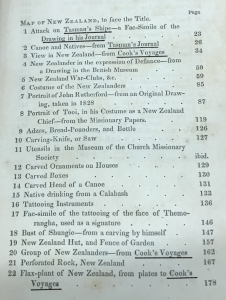
Despite the authorial uncertainty, it is clear that the text itself was written by Western folk for Western eyes. The target audience was likely a large body of people, perhaps anybody interested in travel or world history. It contains anglicized views of the native population of New Zealand (particularly that their way of life was savage compared to modernized America and the arrival of James Cook was a blessing for them), perfect for the New England middle class that would be unable to travel to New Zealand.
I unexpectedly discovered a rich history as I searched for the origins of History of New Zealanders. Although the specific author alluded me, I was able to find an extensive list of sources of information and similar texts with similar mysteries. Somebody must have written these texts, but why keep it anonymous? Perhaps it is because there really was no one author- the sources of the information were so many, one man could not take the credit.