The version of the Vulgate New Testament Bible I decided to study for my pet book project was published in 1493. The book is 353 pages long and contains both the New Testament and interpretations of the Biblical text alongside it. The text and interpretation are written in Vulgate Latin. The book was published in Nuremberg Germany by Anton Koberger and has a colophon at the end containing this information.
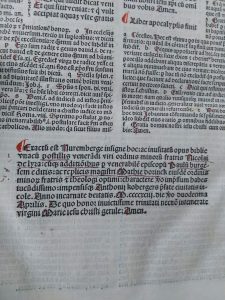
I found myself enchanted by this book’s incredible age. The Vulgate New Testament is an incunable. It is older than the Protestant reformation. It is older than Shakespeare’s plays. It is older than the Jamestown colony, older than the United States. And it was sitting right in front of me. The emotion I experienced was similar to the one I had looking over the chasm of the Grand Canyon. I felt dwarfed by the book. I believe this was my primary reason for choosing it since the age of the book alone made me want to know everything about where it had been and how it had gotten here.
The book was in an interesting condition. I’m not entirely sure how to quantify the condition of a book that old. What I can say that it looked like it had been well-used. There was evidence of being eaten by bugs, evidence of water damage, and the pages were ragged and stained. However, much of the book remained intact.
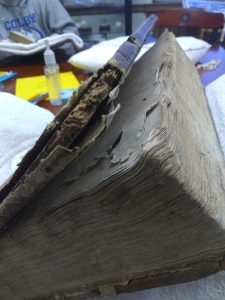
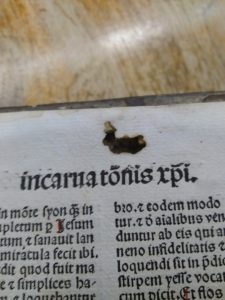
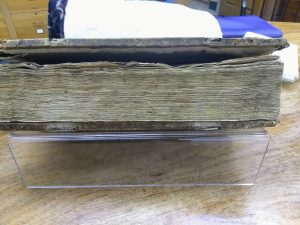
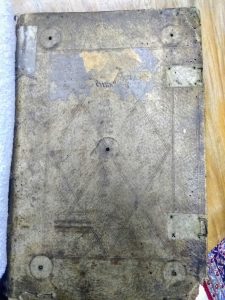
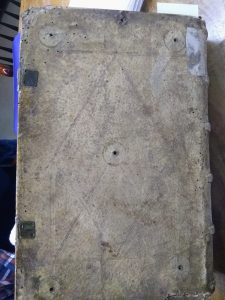
The book has some curious physical details I would like to outline here. Starting on the outside, the book was bound in what I believe was its original pigskin. While the binding was peeling and soiled, it remained intact despite the years. The covers appeared to have been engraved with a diamond pattern, and they also had circle-shaped impressions on the front and back indicating that embossed metal may have been put on it. Also on the binding, there was evidence of removed clasps. Other interesting kinds of damage found on the binding were the holes in the wooden cover and in the binding indicating that a hungry bug has consumed parts of the book. The paper inside appeared to be expensive and the book was large, measuring about a foot or greater in height and about four inches thick.
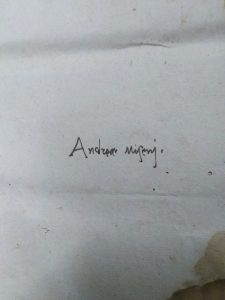
Inside the book, there was evidence of use by a scholar who appeared to be named Andreas, though I couldn’t read the last name. He had transcribed his name on the front page, and what appeared to be his handwriting appeared often in the margins. One thing I found interesting was that the ink was in different colors depending on where you were in the book, indicating that Andreas ran out of ink and had to mix new ink to continue his studies. The text he wrote appeared to be in Latin and in Greek, so I was unable to read it, but because of this I assume he was some sort of scholar. His handwriting appeared primarily in the first third of the book, as well as after the colophon.
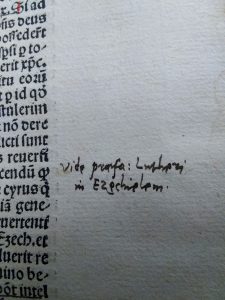
The text of the book was written in Latin and had a small, difficult-to-read typeface interspersed with rubrication. One very interesting feature of the book was the layout of the text. The book had the text of the New Testimate inside the page, with the interpretation of the text set around it. This interpretation of the text is called the glossa, and it would aid the scholar in his study of the book.
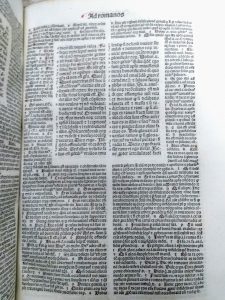
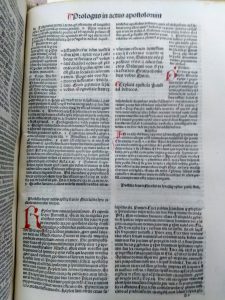
I’m looking forward to investigating the way the book has been used. The size, binding details, and ornateness of the book make me curious about its use: it seems too large to lend itself to household use but has evidence of use on and inside it. The marginalia, damage, water stains, and fading all indicate extensive use over time. Who used it? How might it have been used? I hope to find clues to this throughout my analysis.