The book I chose is Moses and Aaron: Civil and Ecclesiastical RITES, Used by the ancient Hebrews; observed, and at large opened, for the clearing of many obscure Texts throwout the whole SCRIPTURE. Which texts are now added to the end of the Book. Wherein likewise is shewed what Customs the HEBREWS borrowed from Heathen people: And that many Heathenish Customs, originally, have been unwarrantable imitations of the HEBREWS. 10th edition (Moses and Aaron) by Thomas Godwyn, B.D. printed in 1671 in London by S. Griffin for Andrew Crook.

I chose this book because I’m Jewish and I like learning about Jewish history. I really liked reading about Jews and Medieval perceptions of Jews in Global Middle Ages last semester and I wanted to continue to examine that tradition.
The content of the book is pretty much outlined in the title, but there’s a little more to it. It’s broken down into six chapters, or books, each outlining a different segment of Jewish culture. This is all outlined in a table of contents. In addition to the main text of the book, there is a dedication at the front, after the title page, and an advertisement of other books available from the publisher at the end of the table of contents. At the end of the book, there is a list of sources cited by Godwyn. Following that, there’s a table, almost like an index, of biblical references, telling what book and chapter was referenced, and on what page. Throughout the main text, there is a lot of paratext. There are headers that give the title of the book on the left hand page, and the title of the section on the right. There are also page numbers and catchwords to help in both reading and in binding the book correctly. There are notes printed in the margins as well, written in English, Greek, and Hebrew.
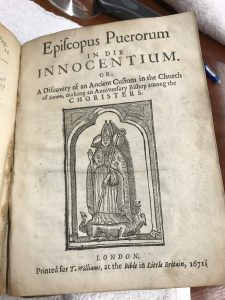
Curiously, in addition to all of the stuff from Moses and Aaron, there’s also a section from another book bound in at the end. The (a?) title page, and pages 95-120, from a book called Episcopus Puerorum In Die Innocentium, are bound at the back of the book, after the biblical reference table. This book was also printed in 1671 in London, for T. Williams at the Bible in Little Britain. There is no indication as to whether or not this was printed by S. Griffin, who printed Moses and Aaron. Neither book indicates where it was bound. Pages 95-120 of Episcopus Puerorum do not constitute a full chapter or section.
The book itself is small, about the size of a modern trade paperback or hardcover novel. The cover is not particularly decorative. It’s made of cardboard and is covered in two different kinds of patterned paper, one near the spine, and one covering the rest of the page. What remains of the spine is a shiny, lacquered paper, dark brown in color. The book is printed on paper, which is sturdy enough, but nothing too fancy. It does feature a watermark, though I can’t tell what the design is.
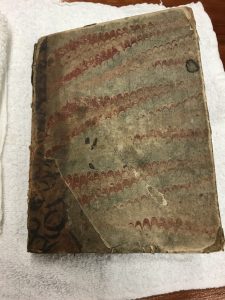
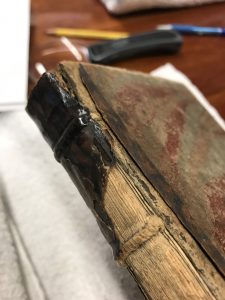
The book has sustained a fair amount of damage, but that’s mostly confined to the binding. The spine, as I mentioned, is all but gone, exposing the binding. The actual stitching is mostly intact, though there are some loose pages in the back of the book. The paper covering the cardboard on the cover is peeling in places, and gone in others. The pages are in much better shape than the exterior. There’s some foxing, but not to the point that it obscures anything. Many of the pages are folded or dog-eared in some way, and some of them are uneven, leading to further folding. There are examples of ink smears on the pages, but there’s no trace of water damage, so this smearing likely happened when the book was printed and bound.
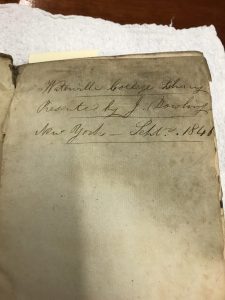
There is a lot of evidence of use in the book, though none in the form of written annotations or doodles. There is extensive evidence of the book’s use by first the Waterville College Library and then the Colby College Library. The book was given to Waterville College in 1846 (near as I can tell, it may be 1841) by a J. Dowling of New York. From there, there are other stamps and notes that indicate that the book is property of first Waterville and then Colby College, as well as things like call numbers and locations within the library. There is also a pocket in the back for a circulation card.
I’ve still got a lot of questions about this book that I’m going to try to find answers to. I really want to know how those extra pages got there, but I’m also interested in finding out what it was up to from 1671 until 1846.