In this class, we introduced the concept of iconography, which refers to the study of how certain objects are presented in the image. We discussed the change in painting: style changed from golden to more real-life colors, and structure changed from having several sections to a more unified space. Then, The Coronation of the Virgin became the main character of our class. As I’m born in an environment where religion is somehow far away from my life, Catholicism is a field which I have no experience or background knowledge of, which means, on the on hand, I now get the chance to learn something about it, and on the other hand, some concepts are unfamiliar and confused. For example, I still do not quite get the point of “Trinity”. It is the father, son, and holy spirit, but what it means to be distinctive but one entity? Anyway, the altarpiece is so vivid and full of details! I can not realize there are so many objects, religious beliefs, and allusions contained and being presented if I didn’t read the essay about it. Although I am confused by the religious ideas, I fully get the point that altarpiece, though today is more appreciated on its aesthetic value, had its true functions in religious and social life in the past.
Author: Sophie (Page 3 of 3)
The first important point of today’s class is what is called “name recognition”. When we walk into an art museum, the first thing shown on the label beside an artwork is the name of the artist. Such an emphasis on artists can create bias, for people would always pay more attention to the artist they know, i.e. the famous master such as van Gogh and Da Vinci, and ignore the art created by someone unfamiliar or anonymously. Deciding which artworks to pay more attention to and appreciate more based only on who created them can lead to some great anonymous work, for example, be out of sight. This reflection definitely makes me more conscious about my own bias on the artwork, and next time I visit an art museum, the names out of my radar may instead catch more attention since they now successfully raise my curiosity.
The next important concept is “Deaccession”, which refers to the act of museums selling their artwork to the public. That causes controversy and many people disagree with it, since masterpieces may be transformed into private property and disappear from the public. The reason also includes that artwork can not be protected well outside the museum or that the museum does not have the right to sell the artworks since they are not the creator.
We also discuss contemporary art, which is often be characterized as “a kid could do it” and “I don’t get it”. Instead of emphasizing more on the craftsmanship and skilled painting technic as in the ancient time, modern art underscores “idea” and “concept”. What it means is that people today are buying ideas of artwork for its metaphor or innovation. I guess there is no such thing as which one is better, the craftmanship or the embedded idea, for each one has its uniqueness and reason. Though contemporary art may seem to be easy to create without great skills, innovative ideas embedded within can be something we can learn from rather than mock at.
The followings are the craftsmanship that I felt really great about when I was wandering around the museum of art.
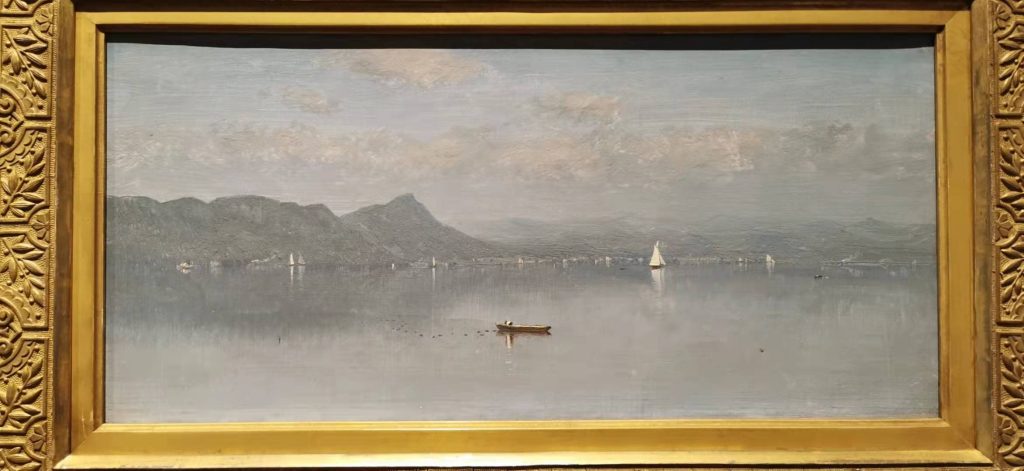
This is a landscape painting with the material being oil on canvas. The details are amazing. The man bowing on the ship is so vivid though the actual size of him on the canvas is only about half a cetermeter! That definitely represents a skillful practice of drawing tiny staff with oil from the artist. This painting comes from Gifford, an American who lived between 1823-1880.

This painting of the sunset is great for it successfully creates a depressive while peaceful atmosphere around the painting and makes visitors stop and gaze for a long while. The color of trees is black, which is weird and rare in landscape paintings, so I guess that is why I feel depressed when I watch it. This painting is made of oil on linen and created by Alex Katz, who is an artist born in 1987, a much more modern-time painter.
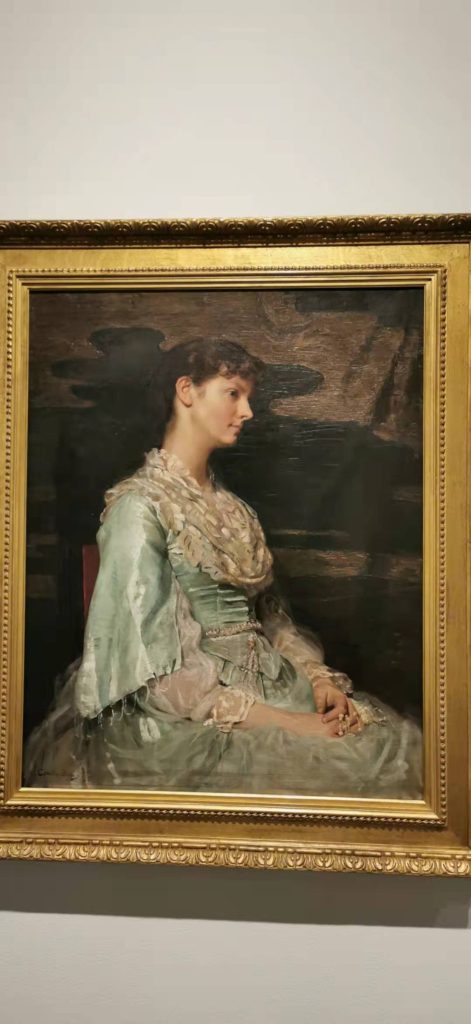
I favor this portrait painting because it depicts the peacefulness, soft and gentleness from the character’s eyes. The drapes on her dress are also detailed and vivid. The play of light and shadow shows the high skill of the artist’s portrait painting. This painting is made of oil on canvas and created by Beaux, who is an artist living from 1855 to 1942.
The most important takeaway from yesterday’s class is the idea of how we perceive the past. Ethnocentrism is something we try to avoid nowadays, which refers to judging other cultures with the values of our own culture, but it seems that we always do that unconsciously in regard to the past, judging the past, whatever its culture or lifestyle or anything else, with the modern values. Is that always true that human is continuing progressing throughout the history? Is every aspect of modernity superior or better compared to the past? One theory called the “teleological” point of view thinks that history is a straight line and things always get better and better while moving forward in time. But that may not be the truth. How should we define “better”, for example? The current meaning of “better” may refer to phrases such as faster, wealthier, life being more convenient and intelligent. But these are the values we contemporary people prefer and not necessarily what the ancient would feel needed. Just like the example raised in class, there is no absolute “good” or “bad” distinction between life in the modern city or within nature like lake and mountain–just a matter of personal individual temporal preference. These above thoughts and reflections are definitely insightful, for in the future when I think about the past, instead of being pitiful at the first second, I may ask, what it is like through the eyes of the ancient.
Today is the first Art257 class for this semester. Here are some points that left me with a relatively great impression. “Renaissance” means rebirth, and that means something had died, but what exactly does “something” refer is not yet clarified. Based on the so-far readings and knowledge, “something” may refer to the lack of creativity and humanism in European culture and art during the medieval period. This may not be correct and hope I could give a more precise answer after a few more class. The pictures of two little angels from Raphael’s painting shown in different modern objects, such as t-shirts and phone shells, are interesting. It makes me think about how art made in one certain period can obtain some totally different functions during the following human history. Being the altarpieces originally, it now becomes the image decoration being able to be printed almost everywhere. Its meaning also changes from merely ritual to more aesthetic, from something sacred to something that can be consumed and utilized by everyone in daily trivial life. Such a huge change, I think, is exactly the reason why we need to perceive the artworks in the Renaissance period through contextualized eyes in order to better understand and appreciate them comprehensively.