Today in class we discussed storytelling and narrative in the pieces that we explored. An interesting topic we discussed that stuck with me was the cross between secularism and religiosity in these pieces. For example, Raphael’s Entombment was a depiction of a significant religious scene but it included the personal touch of the patron, featured in a prominent position in the piece. This was quite troubling to me as it is so clearly out of sync with what the altarpieces would’ve needed to be for. I can understand why Luther would’ve had problems with the rich and the richer creating these private worship spaces that were altarpieces or works that were depicting traditionally sacred scenes with a secular twist. The cinematic character of these more narrative pieces was very interesting, especially the use of the different moments in time cued by the same clothing and/or identical objects in different spacings in the pieces. Something that I really enjoyed today as well was the history of the saints and the fact that Visari actually used that same format to create his compilation of acclaimed artists.
Author: Faith Nkansah-Siriboe (Page 2 of 2)
In our final class sessions on altarpieces we discussed the inner workings of the Portinari and Isenheim altarpieces. Both stunning works include huge amounts of iconography, some unique to their pieces but some being regularly occurring motifs from other altarpieces we have seen throughout the class. The Portinari altarpiece contains a number of very interesting pieces, from the narrative add in of a pregnant virgin Mary and Joseph fleeing to safety on a donkey outside of the city, to a prominent featuring of the patron’s entire family. Of which we used to date the age of the children and confirm exactly which family they hailed from.
The Isenheim altarpiece was equally as exquisite, if not more, with all of its minute details and narrative flowings. It was made for the Antonite monastery, a monsatery of St. Anthony Abbot. The interesting throughline of the altarpiece was its deep connection to St. Anthony and the healing of those with ergotism. As Christ is featured with much of the same skin conditioning that many of the patients at the monastery were expected to have. It drove home the point, especially with the deeper panels revealing the perfection of Christ’s skin after His resurrection, that those who were lying sick and dying could not only relate with their savior in a deeply personal way, but they could live having hope that their condition would only afflict them for but a moment compared to eternity in perfect health.
These two class sessions were speaking on Jan Van Eyck’s Ghent Altarpiece, Rogier van der Weyden’s Entombment, and the Seilern Triptych. These three were fantastic pieces on their own but they were especially crucial when thinking about northern altarpieces in the renaissance period. Some main takeaways from each of these altarpieces are the Arma Christi (or the arms of Christ), the different ranges of emotionality/a more pathetic approach in the details of the northern altarpieces, and mixture of the technology and iconography that were seen in many of these pieces. We saw that many of the works’ first panels included rather muted tones, with not much vibrant color and rather simple scenes. However as we open up the panels, we get revelations in both the artistic and religious aspects of the pieces.
Today’s class was chock full of iconography and I guess you could call them, typical iconographic examples for that time and place in art history. We focused on the different ‘renditions’, if you want to call them that of Cimabue’s Madonna Enthroned and Child (1280-90). Some major takeaways were the physical and spatial depiction of the Madonna and the child Christ. Typical to that time period, the figures were not very realistic looking, nor were their clothing, or locations. Some iconography we saw was that of the prophets, given away by their physically lowered position and the incorporation of scrolls and the Madonna, who was in her classic blue and elevated physically. Then we looked at Giotto’s Madonna Enthroned (1310), which gave a more realistic rendering of the mother and child. There was a lot less linearity and the Madonna appears much more nurturing. Lastly we looked at Duccio di Buoninsegna’s Madonna Enthroned. All three helped us get a better understanding of how the work of the time in Italy evolved as time went on.
In this class we jumped right into a discussion about what iconography actually is. Using the etymology of the word (‘icon-‘ Greek for image, ‘-graphy’ coming from the Greek graphine, or to write) we came to the working definition of the study of the ways a subject matter is represented. I believe today was the first day we were formally introduced to the polyptych style of altarpieces. Those or pieces with several panels and the general progression as time went on was to go from the segmented polyptych style to a more unified piece. Although we did get to see in one piece that although it was one unified piece, it still incorporated the panel-like separate.
Two other parts of class I found especially interesting were (1) the beatific vision that was captured in many an artwork and (2) where altarpieces originated from. I had never heard of the beatific vision but its interesting to see artists takes on it, seeing as those its a vision premised on the fact that you’ve made it to Heaven already. The second was also interesting because it seemed a bit contradictory to me. Thinking of Christ as someone who was for the masses, yet those who felt the most pious made a point to use their riches to create a privatized worshipping experience. All the while, the worshipping assistant is being pushed to the wall, but who am I to judge?
In this class we dwelled a bit on the connection between the reverencial description of the museum by Goethe and the idea of a museum being a ‘temple for muses’. I found the conversation interesting especially taking into account the questions some might have about the craftsmanship and artistic legitimacy of contemporary art.
We then dove into a conversation on altarpieces. I found this most intriguing as I really love churches and it brought up a lot of questions for me, specifically as Professor made the contributions about these pieces being out of their ‘natural habitat’, being stationed in museums. The altarpieces, she described, as almost utilitarian which is so fascinating, especially because they were so beautiful and some of the earliest examples of art that I had ever seen. Im excited to talk more about altarpieces and the way they were thought up in next class. A cute aside that we got into as well was about frames and how the frames are a crucial part of any work of art, which I would’ve never thought of.
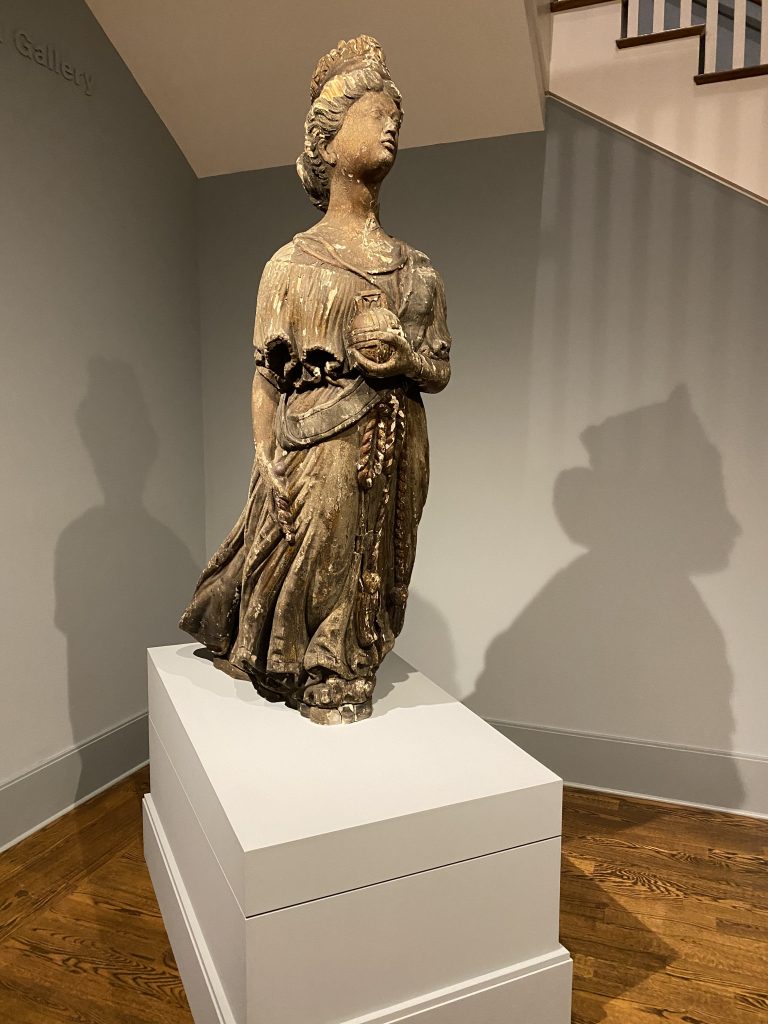
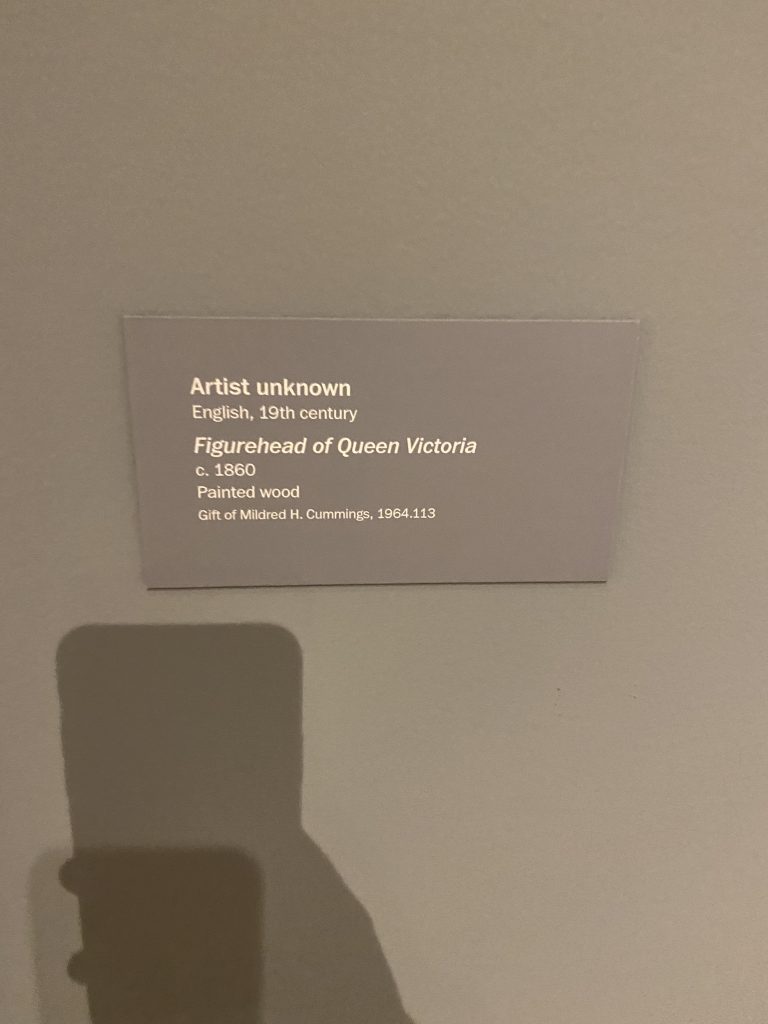
When walking through the museum, I took note of all the different mediums and craftsmanship. I wouldn’t be able to say definitively if certain pieces required more skill or not, as Professor remarked the other day that the stylistic choices didn’t always translate to artistic ability. In the area of the sculptural pieces, I would like to take into account the technologies of the time. I saw a wooden sculpture that had been crafted in 1860 and it was fascinating to see.
I saw many oil paintings, many of them on canvas and some on linen. Some of the paintings, depending on their style, gave me the impression that the craftsmanship was a bit higher but at the same time I’m not really wanting to say specifically if one needs more craftsmanship or not. I saw a good number of the sculptures made out of bronze but this one made of wood was amazing to me and it seemed to require a high amount of craftsmanship.
Our second day of class was very enlightening, and I believe my favorite part was our short conversation on humanism. It seems to place a lot of things in perspective for me when I think of how the ‘progression’ in the art and the history of the Renaissance move forward in parallel, given that shift in mindset from “viator mundi” to “faber mundi”. When I think of the ways in which men like Vasari spoke of art, specifically Florentine art, it makes me see them in a much less favorable light if Im to be honest. Their arrogance makes me want to look more into the work of the Middle Ages and such to see what was so wrong with it.
I also really loved Professor’s callout about the naming of certain art genres and their origins, drawing from the Goths and other ‘barbaric’ peoples. It builds upon the shakiness of that teleological frame of looking at history.
The first day of Renaissance Art was definitely interesting and gave me a good first impression as its my first art class at Colby. That’s all to say, I really enjoyed the way Goethe likened his experience with the art to being in a “House of God”. I think those experiences, both being in a holy location and in the museum, are so visceral and unique that it underscores, for me, the longevity and variety of impacts that art can have on the body. Having the originally purposed location be a holy altar makes me see the connection so much clearer.
What also struck me was the conversation on Renaissance and specifically the mentioning of the requisite death to now understand the ushering of new birth. It makes for fertile ground, in my opinion, to ponder on which other historical gravesites were transformed through the emergence of newly birthed items of relevance to deem the point in time one of a “renaissance’. After the first class I’m definitely excited to dive into to more of the art and ask some more questions about Renaissance art and how it was translated over time.