In 2016 in America, one in five children have some form of learning or attention issue. In addition, in 2017 it is estimated that more than 200,000 college students have a learning disability. There are several factors working against these students including misinformation and not receiving the accommodations and support they need.
Being properly informed about learning differences is essential to a student’s success. When a student has a learning difference it needs to be addressed and accepted so that proper action can be taken to help accommodate the student. However, a study conducted by the National Center for Learning Disabilities (NCLD) found that “48 percent of parents believe incorrectly that children will outgrow these brain-based difficulties.” If it is believed that children will outgrow their learning differences, then the effort will not be made to give them the accommodations that they need and these students will continue to struggle. As a result of not receiving the proper accommodations and support, students can often act out and not finish assignments. The same study by NCLD found that 33 percent of educators falsely label learning differences as laziness. By being properly informed on learning differences, teachers can become better equipped on how to help students with learning differences and reduce acting out and incomplete assignments.
However, having support from parents and administrators is not enough; students need to be receiving the right type of accommodations for their learning differences. Learning differences can be placed into several categories: spoken language, written language, and arithmetic, reasoning. Due to learning differences, certain tasks can be difficult for these students. This includes difficulties with auditory perception and processing, visual perception and processing, memory, spoken and written language, among others. In order to overcome these difficulties, certain accommodations need to be granted to students with learning differences. Common examples of accommodations include teachers providing students with copies of lecture notes, allowing students to record or type lectures, giving student extra time on tests and exams.
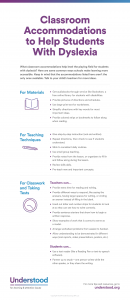
Suggested Classroom Accommodations Source Here.
The lists of difficulties and accommodation are not exhaustive as different students will face different challenges and accommodations need to be discussed with teachers, parents, and students on an individual level. An important note is that accommodations are not meant to give students with learning differences an advantage over their fellow classmates; the goal is to give them an equal chance of succeeding in the class. Accommodations seek to level the playing field for students who are not able to learn the same way other students are capable of learning.
Post by: Michael