According to the Federal Interagency Forum on Child and Family Statistics the percentage of students who speak a language other than English in their home and struggle with speaking English fluently had nearly doubled since the late 1970s. As these populations continue to grow so do concerns about closing the achievement between native English speakers and English Language Learners (ELL).

Image from: https://longislandwins.com
According to a report from the NCES Department of Education website, the number of ELL students has increased from 2002-2003 to 2011, from 9% (4.1 million students) to 10% (4.7 million students), respectively. Based on this trend, we can assume that this number has gotten even higher now that we’re in 2019. What’s alarming about this is the achievement gap that comes along with disparities between ELL students and native English speaking students. In 2011, data from the National Assessment of Educational Progress (NAEP) reading assessment showed that there was an achievement gap of 36 points at the 4th grade level and 44 points at the 8th grade level. This increase in the gap as students progress across their educational careers is especially concerning, since it illustrates that schools need to do a better job of targeting this issue early and throughout schooling for ELL students. Furthermore, in 2013, according to a report from the National Education Association, ELL students exhibited proficiency levels that were 23 to 30 percentage points below English speaking students, with only 3 to 4 percent of ELL eighth graders gaining proficiency in math or reading. As can be seen in the graph below, the 8th grade disparities in reading scores have not changed from 2013-2017, with a large achievement gap existing between ELL students and non-ELL students. Furthermore, the problem doesn’t go away as students progress through their learning, as between 2010-2013, only 61.1% of ELL students graduated, which is 20 points below the 81.4% national graduation rate, according to the same report.
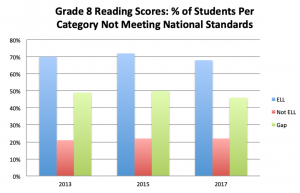
Data retrieved from https://www.nationsreportcard.gov
It’s clear (or should be clear) that the challenges ELL students face in regards to achievement in native English speaking schools and classrooms are deeply rooted and complex. An article by Understood.org goes into detail about the challenges that ELL students face and where these problems arise, as well as more detail on the nuances of the system. According to this article, the most common reasons that ELL students struggle in school are health issues, the normal ups and downs of learning a new language, lack of native language support, and learning and attention issues.
As schools are under increasing pressure to close the achievement gap between ELL and fluent English speakers, curriculums and policies may have damaging effects. A recent New York Times article highlights the ways in which emphasizing English fluency in schools has led to a loss of fluency in native languages. These processes began as early as the late 1900s and had harmful effects on indigenous populations who were sent to boarding schools and scolded for using their indigenous languages. Present day education policies are not as dehumanizing, some social scientists argue that teaching to the standardized tests, administered in English, not only hinders ELL educational achievement but also has harmful cultural implications (see here).
While there are certainly challenges associated with closing the achievement gap between ELL and fluent English speakers, it should be noted that schools must properly understand how they can go about making the educational experience beneficial to ELL students. From the literature, it can be said that Native language support, parent-teacher communication and proper assessment strategies are key to helping struggling ELLs.
Post by: Jacqueline Albanese & Sarah Hancock