One major contributing factor, well understood amongst scholars, of the achievement gap is the socioeconomic disparities across student populations. The ways in which socioeconomic disparities are manifested and how different experiences of poverty affect students differently is a topic that deserve more scholarly attention. Proper nutrition is oftentimes discussed more when it comes to its relation to academic success, as studies have shown that adequate nutrition and consumption of specific nutrients and foods is associated with higher grades, among other facets of higher academic performance among students (CDC Health and Academic Achievement Report). However, one factor that should also be included in this discourse is the effect that homelessness has on academic achievement – especially because homelessness among students is rising. Homeless children and youth are defined as such by meeting a number of criteria. Namely, they do not have access to a fixed nighttime residence due to economic factors or situations of loss or abandonment. Because of this many of the youth who are defined as homeless sleep in friends houses, hotels and motels, trailer parks and campgrounds, cars and other public places.
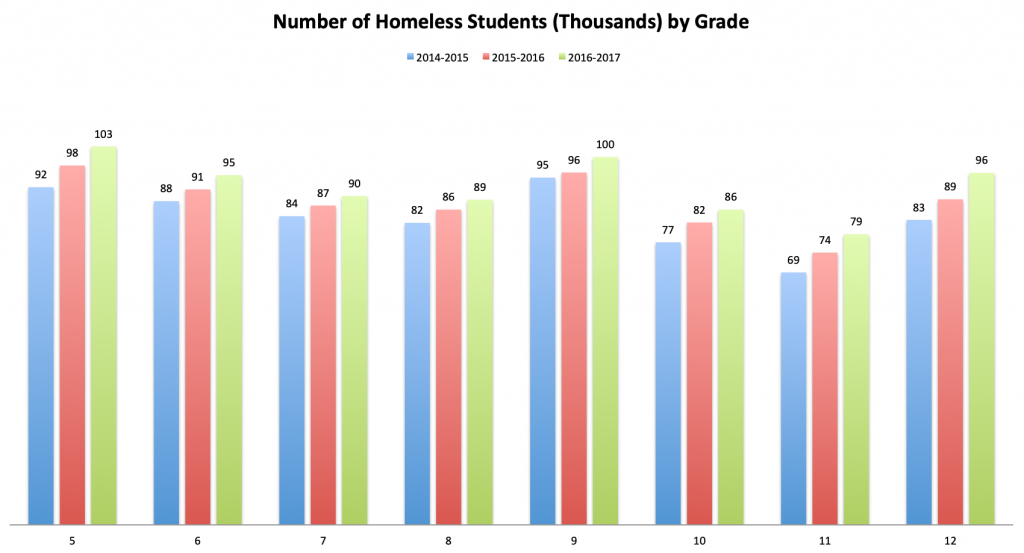
According to an article by US News, the number of homeless students has soared, increasing by 70% over the last 10 years among students enrolled in grades K-12. While this should be of concern for simply a lack of what can be considered a basic need of life in shelter, this is particularly of concern for matters of academic achievement and its relation to the achievement gap.
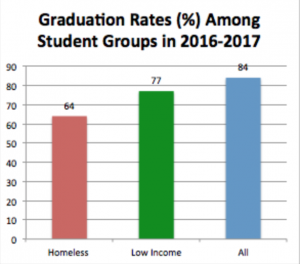
Although all students living in poverty are at risk for facing hardships in academic achievement, studies suggest that homeless and highly mobile students are at an even higher risk that students in poverty who have stable housing. This gap in academic achievement is illustrated by many different benchmarks of achievement including graduation rates. In the 2016-2017 school year, only 64% of homeless students graduated, and this is a much lower graduation rate than that of other poor students, and of the general population of students as well.
If lower graduation rates are still not enough to make a point of how homelessness affects academic performance, proficiency ratings on English language arts and mathematics state tests should do the trick. According to the 2019 report by the National Center for Homeless Education, in the 2016-2017 school year, only 30% of homeless students in grades 3-8 recieved a score that would be considered proficicent on their state reading exams, and only 25.4% recieved proficient scores on their state math exams. If we consider that homeless students are a subset of poor students, and we know that poor students perform more poorly academically than students who do not live in poverty students, it should be noted that homelessness among students is a contributing factor to the achievement gap that needs to be addressed.
Post by: Jacqueline Albanese & Sarah Hancock