On March 8, 2019, The New York Times reported that “A federal judge has ruled Education Secretary Betsy DeVos illegally delayed an Obama-era rule that required states to address racial disparities in special education.” This rule was made at the very end of Obama’s presidency and required that each state must report a “risk ratio” that displayed how large the racial disparity in “special education services, …restrictive classrooms [and] discipline” is in the state.
States with a large risk ratio would be required to spend a portion of their federal education funding to investigate and make plans to fix these disparities.
Racial Disparities in Special Education
The New York Times article scratches the surface of the problem with racial disparities in special education when it says that the higher proportion of students of color in special education classes are “…denying black and Hispanic students a proper education in a traditional classroom setting, and pushing them out of school to lives on the margins of society or in prison.” Other research dives deeper into the problem with racial disparities in special education.
In 2008, a group of researchers out of Indiana University did a systematic review of research into equity in special educations studies. One of their main conclusions is that Black, Hispanic/Latinx and Native American are removed from mainstream classrooms and placed in either special education classrooms or removed from school by suspension or expulsion at higher rates than their white and Asian peers. They explain that risk ratios similar to those in the proposed rule have been used to show this in the past:
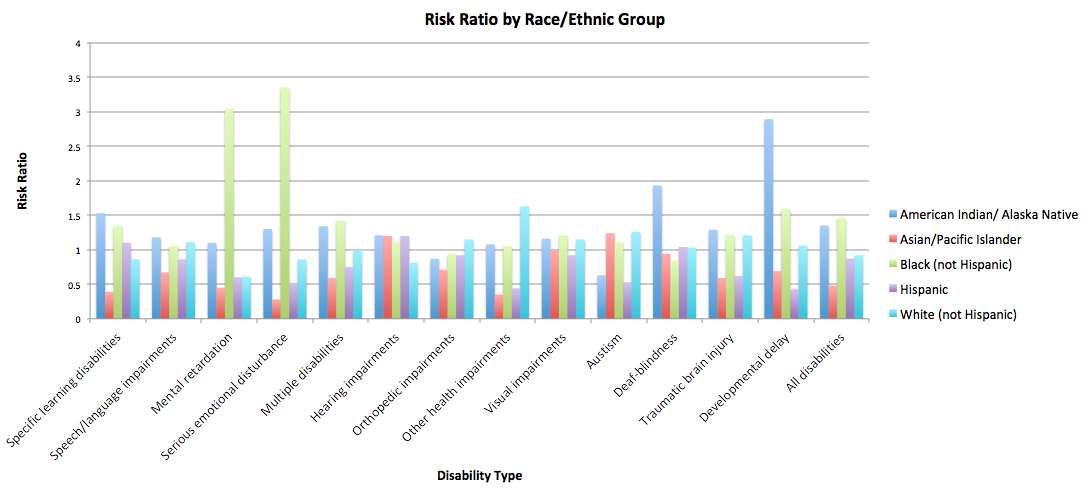
Source: here.
A risk ratio is made by looking at the percent of a given racial or ethnic group that is labelled with a given learning difference divided by the percent of all other racial and ethnic groups that are labelled with that learning difference. For example, the percentage of black students who are diagnosed with mental retardation is about 3 times higher than the percentage of students in all other racial or ethnic groups.
The authors suggest that there are multiple factors that could contribute to this disparity. One common explanation is that psychometric tests that are used to judge whether students need to be placed into special education classrooms are culturally biased, but while the tests have been shown to be less accurate for for English language learners, there is little research to suggest that the students of different races perform differently. They instead suggest that the results of the tests are interpreted differently by teachers, psychologists and guidance counselors. This could mean that a black or Hispanic student who performs similarly to a white student on a psychometric test is more likely to be placed in a special education classroom. They also indicate that teachers who do not understand students culturally relevant behaviors may suggest them for special education services that they do not need. Black students are more likely to be referred to special education services for “behavioral rather than academic issues” (275). Stereotypes regarding students of color related to both intelligence and violence amplify this situation and make teachers more likely to discipline and separate students of color from mainstream classrooms.
The Rule
This background on racial disproportionality in special education provides more context to the two different sides of the arguments about Obama’s proposed special education rule. People who are opposed to the rule say that it is because it could “promote unconstitutional ‘racial quotas’” that the schools feel like they need to fulfill, which could lead to either too few students of color or too many white students being put into special education programs. They also argue that the funding requirements attached to the rules could make it difficult for under-financed districts to operate, making the problem worse not better.
The supporters argue that the Obama rule has explicit safeguards that outlaw racial quotas, so these fears are unfounded. They argue that the rule additionally will never stop students from receiving services that they need but instead will offer “services rather than suspension,” increasing the time that students are in the classroom, which will increase their academic achievement.
The historic research shows that there is a problem with racial equity in special education settings that need to be fixed. The Obama rule makes important steps towards dealing with this problem.
Post by: Kayla Freeman