Literacy is one of the upmost important components at the start of your education. Therefore, the research about the 30-million-word gap between those of high socioeconomic status (high SES) compared to those of low socioeconomic status (low SES) continues to concern education researchers.
It is difficult to manage to achievement gap in education from K-12, and if children from a low SES are already at a disadvantage in their language development prior to entering kindergarten, the achievement gap will begin before education even fully starts. It is thus imperative that language is being acquired similarly across socioeconomic status.
Language development is studied in depth within the field of psychology, and the importance of the development is discussed by many developmental theorists, including Piaget and Vygotsky. Language development is generally considered to take place during birth until 2 years. It is within this critical time and as we age that we learn the components of language, especially the rules of language (e.g. phonology, morphology, semantics, syntax, and pragmatics). In theory, the way one learns language is through imitation, reinforcement and conditioning, and infant-directed and child-directed speech. However, child-directed speech is the most important concept in understanding the achievement gap that develops before kindergarten.
Child-directed speech is used to different extents and in different ways. Once a child is one, the way an adult interacts with them through language is important. Children begin to expand their language through recasting (or when they repeat what was said with synonyms), expanding (repeating what is sad and adding additional details), and labeling (pointing and labeling objects).
So, what happens for the children from low SES that may not have their parents as engaged in this child-directed speech? Without the involvement from parents and the fostering of language expansion, even simply having conversations, children will fall behind – resulting in the gap seen before education even really starts.
Previous research broke down some of the school-readiness skills based on socioeconomic status. Those from the lowest SES are at a disadvantage in most language skills compared to their peer from high SES household, in such areas as counting, recognizing alphabet letters, and identifying the sounds at the beginning of words (see Figure 1). Noteworthy, is the difference in the amount of time a parent has read to their child. The difference is around 40 times from low SES (25 hours) to high SES (1000 hours). Reading to a child exposes them to words, helps strengthen cognitive synapses, and puts them at a level ready for kindergarten.
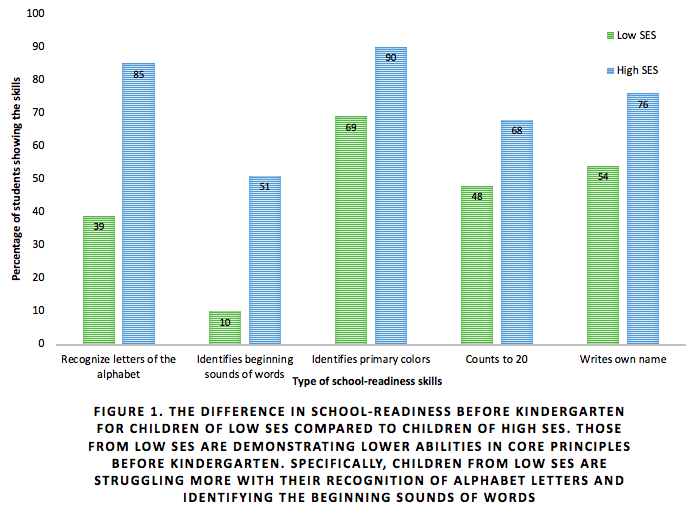
This difference in language learning at a young age because of socioeconomic status is both due to resources and parental involvement. In low SES, there is less access to books. In addition, these parents may not have the time to spend with their children reading, whereas in higher SES household, there may be a range of books at different levels, flexible time from the parent, or a hired nanny.
Furthermore, parents in low SES believe that there is a separation between school and the home. Research from Lareau (1987) has shown that high SES parents are more likely to engage in learning with their children at home as an extension of the school, whereas parents in low SES think that their role is with behavior and it is up to the teachers to instill the knowledge. With these different mindsets, parents in low SES households may be less likely to engage in stimulating conversations with their young children and read and teach them language through application.
Overall, the connection of literacy to the achievement gap is undeniable, and underdeveloped language can be the start of the achievement gap. It is important that language learning is taking place during these critical periods of cognitive development in very young children in order to help stop the gap before it starts.
Post by: Maggie Hall