Much of the discourse surrounding the black/white achievement gap in public education is concerned with the forces that cause such disparities in academic achievement between racial groups. Major topics of discussion and research include school funding, teacher quality, curriculum rigor, family’s socioeconomic status, summer activities and extracurricular opportunities. Scholars, specifically sociologists Edward Morris and Brea Perry, have identified a key factor in the achievement gap equation that often gets neglected, which is the way in which schools carry out disciplinary actions.
Black students and students with disabilities are disproportionally suspended from school compared to white students and students without disabilities. According to the U.S. Department of Educationblack students are three times more likely to receive an out of school suspension than white students. The chart below depicts the percentage of public school students, both with or without disabilities, that received one or more out of school suspensions in the 2013-2014 school year, by race/ ethnicity.
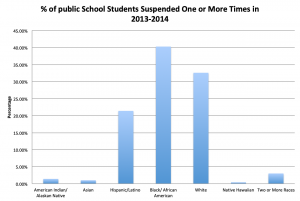
The Civil Rights Data Collectionmakes this data public and it has been observed by scholars and policy makers, however Morris and Perry argue that there exists a gap in the literature regarding the ways in which unequal sentencing of out of school suspensions may contribute to the achievement gap. Their study revealed that students who were suspended performed more poorly on end of the year examinations than they did in years that they were not suspended. In addition, the students in the study who were suspended every year that the study took place scored an average of 15 points lower than students who had never been suspended. Because an out of school suspension contributes negatively to a student’s academic achievement and black students are more likely to be sentenced to an out of school suspension than white students, the study suggests that suspension can contribute upwards of one fifth of the achievement gap.
This research reveals the problematic nature of the widely accepted system of disciplining students. Under preforming students are more likely to act out disruptively in school leading to disciplinary action such as out of school suspensions (see hereand here). Therefore, it is often likely that the students who require the most attention and resources in class are being denied access to such opportunities because they are asked to leave school altogether. Thus, the student continues to fall behind while their peers continue to move ahead.
Reconsidering how schools discipline their students may be a progressive step to narrowing the achievement gap. Some school districts, such as Highline Public Schools, located just south of Seattle, have gone even further by restructuring their school day in order to prevent disruptive student outbursts during the school day (see here). The district adopted a program created by Yale University in order to make schools feel more comfortable and safe for students. For example, the school day begins with students engaging in personalized conversations with one another and with their teachers as a way to increase social skills and create deeper relationships. The program has been very effective in changing the culture within the school as the district reported that between the years of 2013 and 2016 the number of expulsions and out-of-school suspensions had been reduced from 1,628 to 475.
Public schools have an obligation to deliver education to all students and it is clear through the achievement gap discourse that education is not a one size fits all system. School districts may need to invest more time in developing systems that cater to students who are likely to act out and disrupt class rather than resorting to removing the student from the school altogether.
Posted by: Sarah Hancock