Whether one follows the news religiously or just occasionally indulges in a 5-minute binge-watch of CNN or Fox News, it’s no doubt that the decisions and proposals made by the Trump Administration consistently stir up talk – both positive and negative. In news that pertains to the Education Department, just a few days ago, the Trump Administration proposed a $7.1 billion funding cut to the Education Department, with a proposal that suggests eliminating 29 programs (ABC News, 2019). Some of the 29 programs that were suggested for elimination include after-school and summer programs for – you guessed it – students in high-poverty areas. Additionally, the article by ABC News reported that the budget cuts would have more of an impact on public funding, students with special needs and students who are of means below the poverty line. When it comes to matter of the achievement gap, this is a huge issue.
One thing that we know for certain is that the summer is an extremely key time for matters of increasing or decreasing the achievement gap. In an article titled “The Impact of Summer Setback on the Reading Achievement Gap” by professors of education, Richard L. Allington and Anne McGill-Franzen, it was reported that studies have shown that between 2nd and 6th grade, the difference in progress made over those four summers can account for 80% of the achievement gap between economically advantaged and economically disadvantaged schools.
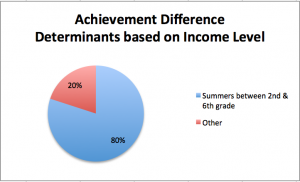
With the Trump administration’s proposed budget cuts, summer programs could be eliminated in economically disadvantaged schools. As these schools are already fighting a losing battle, this will make matters even worse. For example, in New York State in 2018, for students in grades 3-8, 61% of those who were not economically disadvantaged achieved proficiency on the NY State English Language Arts exams. However, only 35% of students who were economically disadvantaged achieved proficiency on the same exams.
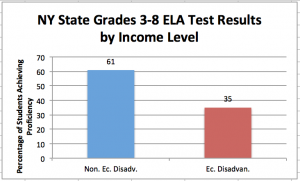
This trend can be seen on the national level as well, and in other facets of the achievement gap, with students of disability performing worse than general-education students (NY State DoE). Clearly, there is an issue with funding and huge differences based on economic advantage or disadvantage with how students are performing.
Since we know that activities outside of school affect student performance, and the 3-month annual gap can accumulate to a year and a half of reading level between the end of kindergarten and the end of 5th grade (Impact of Summer Reading Setback), and that this correlates strongly with economic advantage, this budget proposal would make matters even worse, and certainly won’t be in line with the theme of “minding the gap.”
In a statement made by American Federation of Teachers President Randi Weingarten, the impacts and reactions of negativity by those who truly care about this issue were expressed. Weingarten states, “Rather than increase funding for kids with special needs or for those who live below the poverty line in both rural and urban America… [Education Secretary, Nancy] DeVos once again seeks to divert funding for private purposes.” She even states that if the Administration were to actually listen to the opinions of parents, they would find that “overwhelmingly, parents want well-funded public schools.” It should be stated that these parents are not alone in their wishes, as the Achievement Gap in America overwhelmingly wants well-funded public schools as well.
Post by: Jacqueline Albanese