For many children, having a TV in their bedroom would be a dream come true. A TV of their own that they could watch whenever and whatever they wanted. However, having a TV in your room as a child is a luxury and not something that every family can afford; there are many more important matters such as feeding and taking care of the family that come before giving a child a TV in their room. There is also the concern of whether a child needs a tv in their room and if they can handle the responsibility that comes with it. THE COMMON SENSE CENSUS: MEDIA USE BY TWEENS AND TEENS provides data on tween’s ( children aged 8-12) and teen’s( children aged 13-18) exposure to electronics, including how many of them report having a TV in their bedroom.
Some of the data that this research reports is quite surprising. A higher percent of tweens whose families fall in the lower income category have TVs in their room (66%) compared to children whose families fall in the higher income category( 29%). This is a surprise because one would expect that families with lower income to have more pressing concerns than giving their child a tv in their room. On the other side, one would expect that families with a higher income would have a higher disposable income and therefore be more able to afford a TV for their child’s room. The trend of children from lower-income families having a tv in their room continues from tweens into teens. 69% of teens from lower-income families have a TV in their room compared to 46% of teens from higher income families. Do lower income families actually buy more of their children TVs?
Looking at the data one can see that the percent of children from lower-income families with TVs doesn’t change much between tweens and teens, only 3 percentage point. On the other hand, the number of children from higher-income families with TVs in their room increases an incredible 17 percentage points between tweens and teens. In addition, the number of children from middle-income families with TVs in their room increases from 47% as tweens to 57% as teens. Together, these increases suggest that as children get older, they are more likely to have a TV in their room.
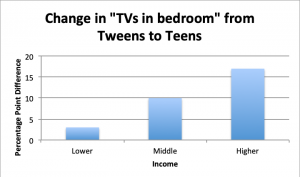
Since children from lower-income families are more likely to have a TV in their room as a tween, why do we not see an increase in the likelihood of teens from lower-income families having a TV in their room? I believe the answer to this is in an area not shown by this data. I believe that children from lower income families are more likely to have a TV in their room because families with lower income will likely have less living space. This could mean that children’s room might double as the family room and the TV in their room is not an extra TV for them, but it is the family’s only TV. This report did not ask questions about individuals rooms, whether it served another purpose, or how many TVs were in the house. If it were the case that more children from lower-income families had TVs of their own, there should be some type of increase in the likelihood of having a TV in your room as a teen compared to a tween as was shown with middle and higher income families. Since there is only a 1 percentage point increase I believe this means that lower incomes families are not purchasing their children TVs of their own and the reason there is such a high number of children from lower-income families with TVs in their room is because the TV reported as being in the child’s room is the family TV.
Post by: Michael Stone