Tracking, also referred to as ability grouping, has become a widespread practice in the United States. From as early as kindergarten, students are frequently placed into small groups determined by their apparent “skill level.” This grouping continues throughout a student’s schooling, and is a major contributor to the pervasive achievement gap. Tracking is becoming more commonplace in schools today. About 68% of classrooms in 1992 grouped student reading groups by skill. That figure rose to about 90% in 2015 (see here). Tracking has been proven ineffective at minimizing and eliminating inequalities, so why does the practice continue to persist in schools?
Why Tracking?
Adam Gamoran, researcher of ability group tracking, contributes the rise in tracking to increased pressure for schools to perform increasingly well on standardized tests due to the No Child Left Behind Act (NCLB) (see here). NCLB, while no longer the ruling legislation in schools, left a precedent of accountability that focused on standardized test scores in reading and math. These scores essentially determined funding and the actually ability for a school to operate (read more about NCLB here). Tracking, in an idealized sense, is designed so that students have access to educational material that is well suited to them as individual learners. Many teachers see tracking as a way to more efficiently and effectively teach students. For instance, children enter kindergarten with varying levels of knowledge– some were enrolled in a pre-k program, some know the alphabet and the sounds correlating with each letter, some have never held a book and some are unable to read or recognize their own name. A teacher instructing this heterogeneous class would have difficulty teaching all of these different students one simultaneous lesson. So the teacher breaks the children into smaller groups, sometimes based on initial assessments, and more often than not, these groupings stick.
There are scholars who support the implementation of tracking, as they believe that it can actually close the reading achievement gap. In an article investigating the Summer Reading Setback, Richard Allington and Anne McGill-Franzen maintain that tracking, specifically in terms of reading, more appropriately matches students with books that they are actually able to read. This leads to greater student efficacy in reading as “greater success in school reading… is central to enhancing out-of-school voluntary reading” (Allington & McGill Franzen 73). In theory, tracking emphasises American ideals such as individuality, efficiency, and competition, however, in practice it benefits the higher tracked and higher achieving students, while leaving those placed into lower tracks behind.
Self-Fulfilling Prophecies and the Gap
The practice of tracking is extremely racially and economically biased. Prominent tracking opponents, Amy Stuart Wells and Jeannie Oakes, find that “low income, African-American, and Latino children [are] consistently placed in low-level classes regardless of their prior achievement” (Wells & Oakes 157). When these students are placed in lower level classes and groups, they begin to internalize this grouping, leading to a vicious cycle of low achievement. Author of Tracking, Segregation, and the Opportunity Gap, Karolyn Tyson states, “the lack of diversity in classrooms works as a sort of self-fulfilling prophecy and a barrier to more equitable opportunities, because it reinforces ideas about a connection between race and intelligence and who is smart and who is not” (Tyson 170). Students who are placed in lower tracks, whether justly or not, do not see a way out of the lower track and continue on a path of lower achievement, always behind their higher achieving peers. Lower tracked students are frequently given less qualified teachers and fewer resources, so their educational experience is neither equal nor equitable.
Researcher Marshall Jean, who studied a group of about 12,000 students, found that students placed in the lowest reading track in kindergarten were never able to reach the reading level of the students placed in the highest group (see here). These patterns that begin in kindergarten continue throughout schooling, and result in a smaller number of nonwhite students enrolled in advanced courses in high school, and lower performance in those advanced classes if they are taking them (see fig. 1). Because of the persistent structural inequalities in the United States, the majority of the students placed into the lowest track in kindergarten are low-income and non-white. This extremely biased practice is hailed as a means to provide students with the specific learning support that they need. However, it keeps those at the top of the educational and societal structure at the top.
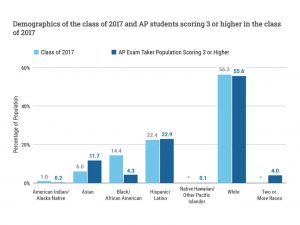
Figure 1, Photo Credit: College Board
Overall, tracking is a direct accomplice to the prevalent achievement gap in schools. Until schools find ways to effectively de-track their classrooms and curriculums, the achievement gap will remain in place.
Post by: Julia Manning