Salopia, Massachusetts recently voted to rebuild Bradley Early Childhood Center, which currently houses the half-day kindergarten and some of the first grade classrooms for the town. Bradley’s building needs major repair and the town’s school age population is growing, so Bradley is moving to a new location that will allow for a bigger school. Bradley will reopen in 2020 as a fifth K-4 elementary school in the town. The opening of the new school is causing controversy because it will require the town to rezone (redraw the lines that determine which students go to which school). The rezoning process provides the potential to narrow (or possibly widen) the achievement gap in town (see my last post about the achievement gap in Salopia here).
The Town of Salopia
The median income in Salopia is $98,800 (see here), but this is not evenly distributed around the town. The map below shows the median income in different areas of town, on top of which I have drawn approximately the current zoning lines with the locations of the elementary schools marked with a green arrow.
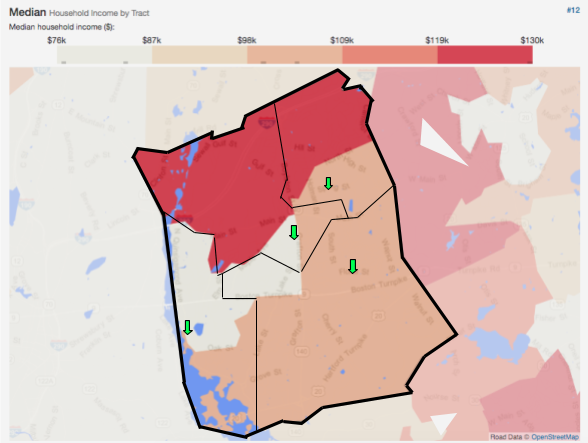
Image 1: Median income of different areas in Salopia (see here) and current elementary school zone lines (see here, here, here, and here)
The median income in Salopia varies by approximately $50,000 in different areas of the town, and the schools have large income disparities.
Massachusetts creates an “Accountability Report” for each town and each school in each town every year based on a combination of state-wide standardized testing scores and other factors. While all of the elementary schools in Salopia receive the title of “Not Requiring Assistance or Intervention”, the school in the lower left quadrant (with the lowest average income) falls into the “partially meeting targets” subcategory, while the other three elementary schools fall into “meeting targets” or “school of recognition” subcategories. Thus, based on the state’s determination, students at the school with the lowest average income are not receiving the same level of education as the other three, which indicates that there is a correlation between families’ socioeconomic status and school performance, emphasizing the importance of the upcoming rezoning.
Socioeconomic Integration
The idea that socioeconomic status affects schools is not new. In 1966, James Coleman published a famous report regarding the achievement gap in the US. Modern research says that the Coleman Report was important for two reasons: “First, it revealed an enormous achievement gap between America’s black and white students. Second, it suggested that the gap arose largely from differences among families.” Efforts to achieve racial desegregation after Brown v. Board of Education (such as busing – learn more here, here, and here) did not achieve the goal of creating equitable educational opportunities for all people. Socioeconomic integration could be the better solution.
Angela Ciolfi, professor of civil rights, says that socioeconomic integration provides a broader and hopefully more successful alternative to racial integration. Socioeconomic integration ensures that there is a mixture of families from different socioeconomic groups at all schools. Research shows that “next to a student’s family, the socioeconomic status of his or her school is the single most important determinant of academic success,” so there is reason to believe that changing a school’s socioeconomic status can change the achievement of its students. As Ciolfi notes, when lower income students are in schools with majority higher income students, their achievement tends to increase. Introducing lower income students into majority higher income schools does not, however, result in lower academic achievement for the higher income students (as long as the majority of the schools remains higher income).
Getting Back to Salopia
A possible solution could be to rezone like this, maintaining neighborhood schools (the new Bradley school is indicated in pink):
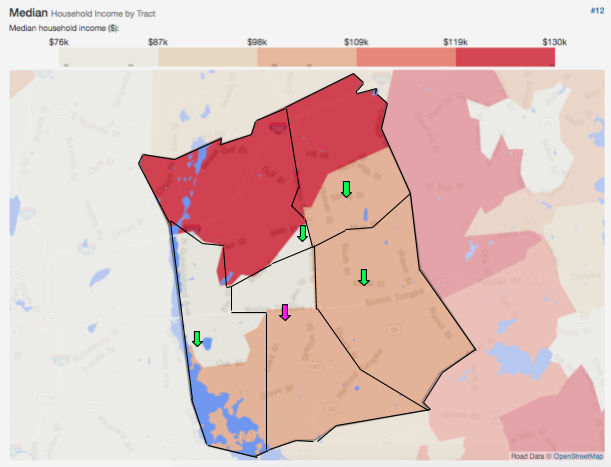
Image 2: Median income of different areas in Salopia (see here) and potential new elementary school zoning lines
This configuration saves money because the town needs to pay for busing if students live beyond 2 miles from school. But as Lora Cohen-Vogel, Ellen Goldring, and Claire Smrekar, education policy professors from the US, note, “studies have shown [the neighborhood school] in general has led to increased segregation… Moreover, under neighborhood schooling, poor and minority children are much more likely to be assigned to schools located in impoverished, vulnerable communities, as these communities are closer to their home.” As is evident in the map above, keeping students in traditional neighborhood schools could mean that students arrive in even more polarized elementary schools.
Therefore, a better solution to the new zoning problem is below:
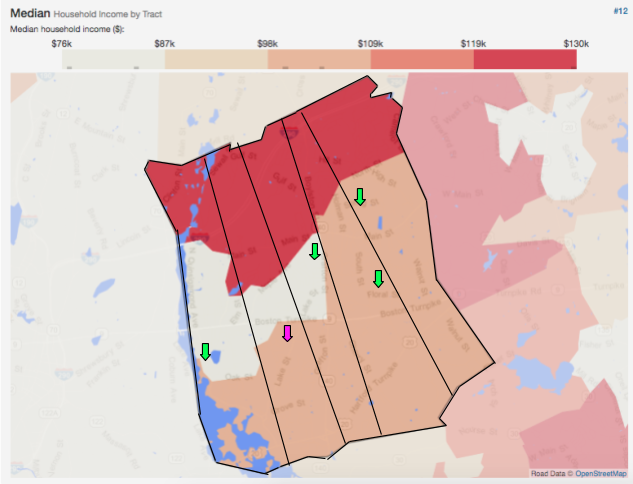
Image 3: Median income of different areas in Salopia (see here) and a better alternative for new elementary school redistricting lines
This creates schools with better mixes of students from different socioeconomic status, which as the Coleman Report and other research above suggested, will improve the academic achievement of students in lower socioeconomic classes.
Although all students in Salopia become integrated at the beginning of middle school, Ciolfi’s research indicates that starting this socioeconomic integration when the students are young will have the most impact on their future success. Thus, if Salopia is serious about boosting the academic achievement of all students – particularly low-income (by Salopia standards) students – then they need to consider that the loss of dollars to busing may be worth achieving socioeconomic integration.
Post by: Kayla Freeman