Long Island is 118 miles long and 23 miles wide. It is home to 127 districts, some of which rank at the top in both New York and in the country. The districts that are not at the top, however, seem to be at the very bottom. The report Long Island Education: Costs and Outcomes has revealed that the difference between schools in wealthier areas has been growing tremendously.
According to Niche, my district, Half Hollow Hills (HHH), is the top fourth district in the county. Of the two schools in the district, I went to the one that was ranked top in the county. Both of the high schools in the Half Hollow Hills are ranked in the top 100 for the state. If you drive 20 minutes over into another district… the story is a little bit different.
Bay Shore Union Free School District (BSUFD) has some of the lowest proficiency scores on the island. It is located on Long Island’s southern shores and shows a very different story about what it is like to receive an education on Long Island. The following two graphs reveal something interesting about the different districts on Long Island when compared to each other and to New York State.
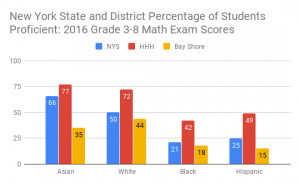
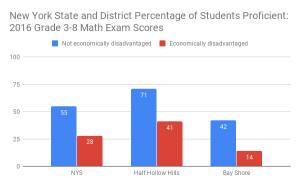
When looking at the different scores of the districts and the state, it is clear that Half Hollow Hills has achieved more success in proficiency scores. This may be the result of what’s going on at home, the teachers, or the makeup of the school itself. But is Half Hollow Hills the better school in all aspects?
When looking closely at the numbers, the achievement gaps between different demographics of students is lower at Bay Shore. The gaps between economically disadvantaged students and students not economically disadvantaged is smaller at Bay Shore. The gap in the percentage of proficient white and black students at Bay Shore is lower than that of Half Hollow Hills. Considering this, which school district is more successful?
In 2002, Half Hollow Hills released a report discussing their plans to close the achievement gap. They suggest practices and policies that will help solve this problem. One category they consider improvement in is “Culture.” This area of their report calls for teachers that will better understand the different cultural backgrounds of students. Niche offers a diversity letter grade to Bay Shore that is two grades higher Half Hollow Hills. It is possible that teachers at Bay Shore are better able to connect with students which has aided in closing that gap in a way HHH has not yet been able to do so. Overall, HHH is outperforming BSUFD but BSUFD is offering more equal educational outcomes to their students. The gaps between these two schools that are so close to each other show how far education on Long Island still has to go to solve the different problems it is facing.
Post by: Sarah Kaplan