Georgia has the nation’s third largest rural school population, but these rural schools are often underfunded, understaffed, and under-performing. Many rural schools are taking great strides to improve their outcomes, but are these improvements equal across disadvantaged groups?
Rural Georgia’s performance on the National Assessment of Educational Progress is among the country’s lowest. Georgia Partnership for Excellence in Education’s research suggests that rural communities are still facing unique struggles that are not being addressed, such as healthcare and economic problems. Their research also focused on the black-white achievement gap, but the organization did not specifically research black students in rural schools. As a case study, I will be examining the achievement gap (in terms of race and socioeconomic status, respectively) in a high school in rural northeast Georgia.
Franklin County High School, like many rural high schools, is majority white (80%) and low-income with almost half of the student body being eligible for free-reduced lunch (47%). 10% of the student body is black, and that percentage is slowly rising every year. According to the Governor’s Office of Student Achievement’s Report Card, black students are almost as likely as white students to have chronic absenteeism, but economically disadvantaged students are three times as likely as non-economically disadvantaged students to have chronic absenteeism. These chronic absenteeism no doubt contributes to the low test scores being produced in rural schools.
To try to increase test scores, the state set improvement targets on standardized tests. Black students, even though they have much lower targets than white students, are not meeting the improvement targets. Economically disadvantaged students, on the other hand, are improving their scores and meeting the targets. Looking at the actual test scores, both economically disadvantaged students and black students are less likely to be labelled “Distinguished Learners,” meaning having a very high score on a subject test, than their more advantaged counterparts. On closer examination, black students are much less likely than poor students to be “Distinguished Learners,” or even “Proficient Learners.”
To try to explain this gap in the student experience, I examined the teachers and administration at the school. Surprisingly, this rural high school has teachers that have mostly either bachelor’s or master’s degrees, and the average years of experience is 15 years. The teacher were almost exclusively full time, and there were almost twice as many female teachers as male teachers. Most interestingly, the administration and teachers were almost entirely white. Though 10% of the student body is black, only 4% of teachers are black. 94% of teachers and 100% of administration is white.
Franklin County has prided itself in raising its graduation rate 4% in the last two years. Upon inspection, that statistic does not tell the full story. While the graduation rate for non-economically disadvantaged students is impressive, the graduation rate for economically disadvantaged students is only 78%. The graduation rate for white students has risen in the last three years, but has actually decreased for black students. While the graduation gap between economically disadvantaged students and non-economically disadvantaged students appears to be shrinking, the graduation gap between black and white students appears to be growing.
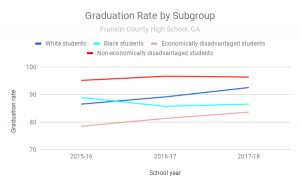
While is may appear as though Franklin County High School, like many rural high school, are making strides to improve their educational achievements, the data suggests that those improvements are largely unequal across disadvantaged groups. While they are making progress in closing the economic achievement gap, the racial achievement gap is still lingering and possibly even growing. Economically disadvantaged students disproportionately missing more school, but black students are not achieving high test scores or high graduation rates. I hypothesis that the lack of racially diverse teachers and administration are contributing to this achievement gap. Rural schools should continue their mission to create equal learning outcomes for students, but perhaps they should focus more on creating a more equitable learning experience for all students.
All data of Franklin County High School from Governor’s Office of Student Achievement’s Report Card.
Post by: Amber Churchwell