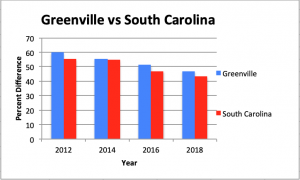
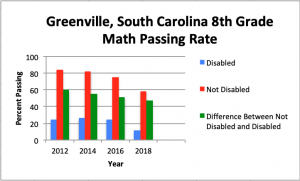
In Greenville, South Carolina there is an incredibly large achievement gap between students who are disabled and those who are not disabled when looking at 8th-grade math scores. By analyzing data from SCPASS one can see the extent of this achievement gap.Back in 2012, 84% of non-disabled students were passing the 8th-grade math assessments. However, only 24% of disabled students were passing the same test. This is nearly a 60-percentage point difference in achievement. However, as years have gone on, the gap between disabled and non-disabled students has begun to shrink. In 2018 the gap between disabled and non-disabled student’s passing rates had shrunk to a difference of only 47 percentage points. However, saying only 47 percentage points feels wrong because even though the district has improved, there is still a large and distinct gap. Even worse is that South Carolina as a whole is only doing marginally better than Greenville. In 2012, the difference in achievement between disabled students and non-disabled students was 55 percentage points. This statistic has improved to 43 percentage points in 2018, but this issue is far from resolved. Even worse is that as the gap between disabled and non-disabled students has improved the percentage of students passing as a whole has decreased.
The percent of non-disabled students passing has gone down from 84% in 2012 to 59% in 2018. On the state level, the passing percent has gone down from 81% to 54%. This decrease could be partially attributed to changes that were made in 2017 when students switched from being marked as “not meeting” or “meeting” expectation or being “ exemplary” to being marked as “does not meet expectations”, “approaching expectations”, “meets expectations”, or “exceeds expectations”. Although some decrease in passing percent could be attributed to changes in the grading scale and any other changes that went along with it, there was a preexisting problem. From 2012 to 2016, Greenville’s passing percent decreased to less than 76 %. In the same period at the state level, passing percent decreased to 72%. This shows that even before changes were made to the grading system in Greenville and the state there was a downward trend in passing percentage.
There are obviously many problems that need to be fixed in Greenville and South Carolina as a whole. Although Greenville’s gap is currently larger than the states, I believe that Greenville is in better shape than the State when it comes to closing the gap. Over the past six years, Greenville has steadily been decreasing the gap by a little more than 4 percentage points every two years. On the other hand, South Carolina as a whole is very sporadic in making changes in the gap. I think that this means Greenville has found some solution to the gap and is slowly chipping away at it. Although the numbers don’t look pretty now, I believe that Greenville has a formula in place that could continue to close the gap. South Carolina could look to Greenville for clues of how to close the gap statewide.