Manhasset, New York is a small, utopia-like town on the North Shore of Long Island. Known as being a part of “East Egg” from The Great Gatsby by F. Scott Fitzgerald, Manhasset is an upper-middle to upper-class neighborhood with affluence and abundant resources. Not surprisingly, its public school district, the Manhasset Union Free School District (MUFSD) is among not only some of the best public schools in the state, but also in the country. According to US News, Manhasset High School is ranked #31 in the state of New York and #200 in the United States. As someone who is an alumnus of the Manhasset Union Free School District, having attended Shelter Rock Elementary School, Manhasset Middle School and Manhasset High School, I’ve experienced first-hand all that Manhasset’s public schools had to offer. With abundant resources, high quality teachers, AP and honors classes, extracurricular activities, an involved faculty and administration, and then some, the MUFSD is a place where students have every opportunity to thrive. However, some students still don’t.
According to the New York State Department of Education website, a huge achievement gap exists in the MUFSD based on the data from the proficiency and scoring levels of the New York State School Report Card 3-8 English language arts and mathematics exams. If we look at the proficiency scoring of white students to black students to Asian students, we can see a huge achievement gap between the black students who achieve proficiency on the state exams in grades 3-8 and the white and Asian students. While there is seemingly a major achievement gap in the Manhasset Union Free School district, things are not all negative. As context, the New York State ELA and mathematics exams are graded on a 1-4 scale. In 2018, 79% of students in the MUFSD scored in the 3-4 range, as opposed to only 45% of students in New York State scoring in the 3-4 range. However, things still appear to be grim for the achievement gap in Manhasset. For example, in 2018, 94% of Asian students achieved proficiency on the state exams and 77% of white students achieved proficiency. However, it’s important to compare that with only 27% of black students achieving proficiency on the state exams in 2018. That is a huge gap. The numbers aren’t much different from the year before, 2017, either with 91% of Asian students, 77% of white students, and only 23% of black students achieving proficiency.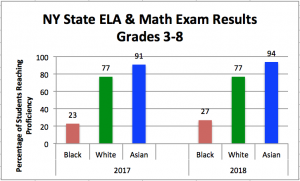
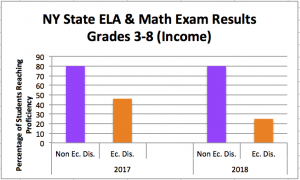
Furthermore, the achievement gap seems to be worse in the MUFSD between economically disadvantaged students and non-economically disadvantaged students. In 2017, 80% of non-economically disadvantaged students reached proficiency, while only 46% of economically disadvantaged students reached proficiency. What makes this achievement gap seemingly worse is that in just the next year, 2018, 80% of non-economically disadvantaged students still reached proficiency, but now only 25% of economically disadvantaged students reached proficiency. That’s a tremendous stride in the wrong direction.
Based on this data, the scores from the NY State ELA and math exams accurately depict what the achievement gap is like in the MUFSD, and it’s relevant to factors outside the classroom. Most of the students and the town population is white, and there are few minorities. Furthermore, most of the minorities do not live in the same Manhasset as the rest of the student population. Spinney Hill, located about 10 minutes outside of the main town, is a community of multiple-family homes and apartments and low-income earners. Most of the black students in the district live in Spinney Hill. Non-coincidentally, the effects of these distinctions are evident in the scores and data of the state tests. Additionally, this data is very much in alignment with what I experienced going to school in the MUFSD. With every possible opportunity to succeed, it always seemed as if those in the minority were not succeeding as much as the white, Asian, and non-economically disadvantaged students.
In sum, while the Manhasset Union Free School District is one that is consistently regarded as one of the best in the state, and while many of its students go on to elite colleges and universities, an achievement gap still exists. As previously mentioned, with every opportunity to succeed, the black and economically disadvantaged students are still lagging behind. In Manhasset, I think Rothstein and his research would agree that factors outside the classroom are definite contributors to this (Rothstein, 2004), yet it is imperative that the schools, teachers and administrators in the MUFSD do what they can to help close the gap that currently exists.
Post by: Jacqueline Albanese